Thank you for attending the 2022 PEACE Pathway Conference. All presentations from the conference are now available for download.


Recording of the conference is now available and can be accessed here.
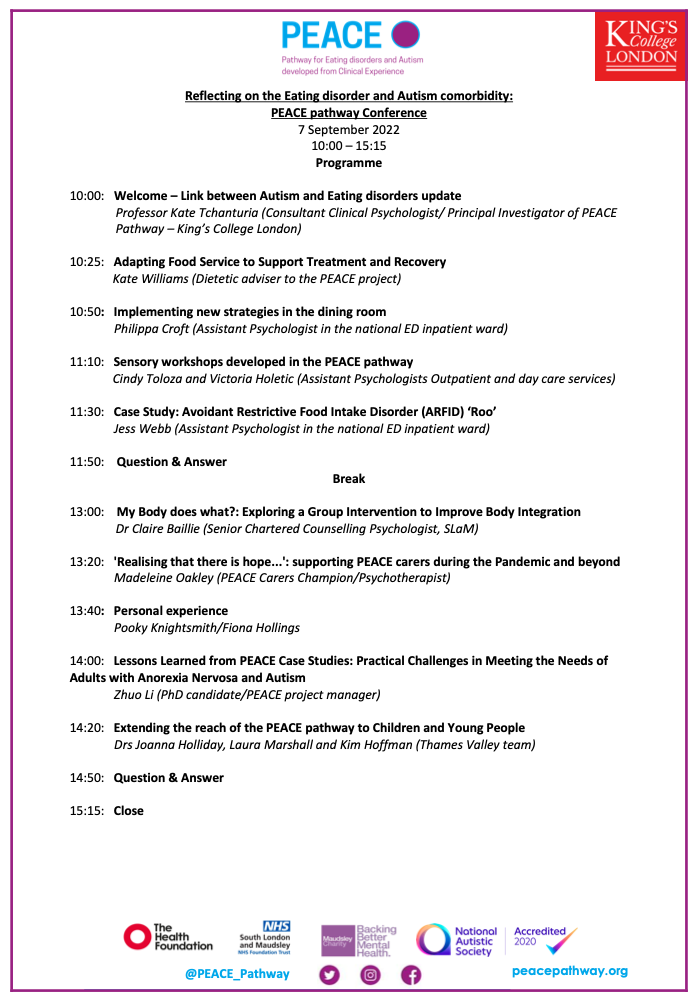
 

Conference Programme


Download presentations:


  1. Welcome – Link between Autism and Eating disorders update - Professor Kate Tchanturia (Consultant Clinical Psychologist/ Principal Investigator of PEACE Pathway – King’s College London)
  2. Adapting Food Service to Support Treatment and Recovery - Kate Williams (Dietetic adviser to the PEACE project)
  3. Implementing new strategies in the dining room - Philippa Croft (Assistant Psychologist in the national ED inpatient ward)
  4. Sensory workshops developed in the PEACE pathway - Cindy Toloza and Victoria Holetic (Assistant Psychologists Outpatient and day care services)
  5. Case Study: Avoidant Restrictive Food Intake Disorder (ARFID) ‘Roo’ - Jess Webb (Assistant Psychologist in the national ED inpatient ward)
  6. My Body does what?: Exploring a Group Intervention to Improve Body Integration - Dr Claire Baillie (Senior Chartered Counselling Psychologist, SLaM)
  7. 'Realising that there is hope...': supporting PEACE carers during the Pandemic and beyond - Madeleine Oakley (PEACE Carers Champion/Psychotherapist)
  8. Personal experience - Fiona Hollings and Personal experience - Pooky Knightsmith
  9. Lessons Learned from PEACE Case Studies: Practical Challenges in Meeting the Needs of Adults with Anorexia Nervosa and Autism - Zhuo Li (PhD candidate/PEACE project manager)
  10. Extending the reach of the PEACE pathway to Children and Young People - Drs Joanna Holliday, Laura Marshall and Kim Hoffman (Thames Valley team)
     

Contributed by:

Keep Reading

You might find these interesting too!

Co-Produced: Episode 1. Inpatient Sensory Ethnography, Lived Experience, and Neurodivergent-Affirming Care

In the first episode of Co-Produced, Adia and Lauren are joined by Dimitri Chubinidze to explore how inpatient eating disorder treatment is lived, felt, and made meaningful through the senses. Drawing on a year-long sensory ethnography of an adult inpatient ward, the conversation reflects on neurodivergent-affirming, co-produced research that centres lived experience. The featured study, shortlisted for the NIHR Maudsley BRC Culture, Equality, Diversity and Inclusion (CEDI) Impact Award, highlights how listening attentively to bodies, senses, and experience can help shape more humane and inclusive care.

Neurodivergent-friendly support and treatment for eating disorders

This blog by Lauren Makin shares insights from recent research on how eating disorder support can better meet the needs of Autistic and ADHD adults. It highlights the importance of recognising neurodivergence and adapting care to sensory, communication, and routine needs, based on what people with lived experience say is most helpful.

Caring in context

A neurodiversity-informed guide for carers supporting someone with an eating disorder, with a focus on autism and ADHD. This resource offers practical, compassionate strategies grounded in lived experience and clinical expertise.

See All